

The Hootcorp analytics lab has been hard at work this week, getting some shots up on random CUSA thoughts that then turn into graphs/tables. I’m gonna drop a few of them here on the site so they’re not only on the @hootstate account. If you’re not an analytics person, you can probably sit this one out in full transparency.
Right now, I’m messing around with an all-in-one receiver metric that aims to hit the same notes as WAR in baseball or BPR in college hoops. I’m torn between naming it SUMPTER or BENYARD, because it makes me laugh when people do NBA stats like DARKO and BRON and so on. Definitely not ready to publish yet, but I’m getting Javon Rogers (+0.48 points) and Dylan Gary (+0.13 points) as the top two for KSU in the very primitive stages. Isaiah Myers (+2.34 points) leads CUSA right now.
Looking ahead to this weekend, FIU DC Jovan Dewitt stressed Kennesaw’s tempo a ton during his press conference. More specifically: How limiting the Owls on first down is the most important factor because of how it affects the rest of the series. That made me want to check how the offense fares based on that hypothetical 4-yard gain Dewitt mentions. Math checks out once you dive in.
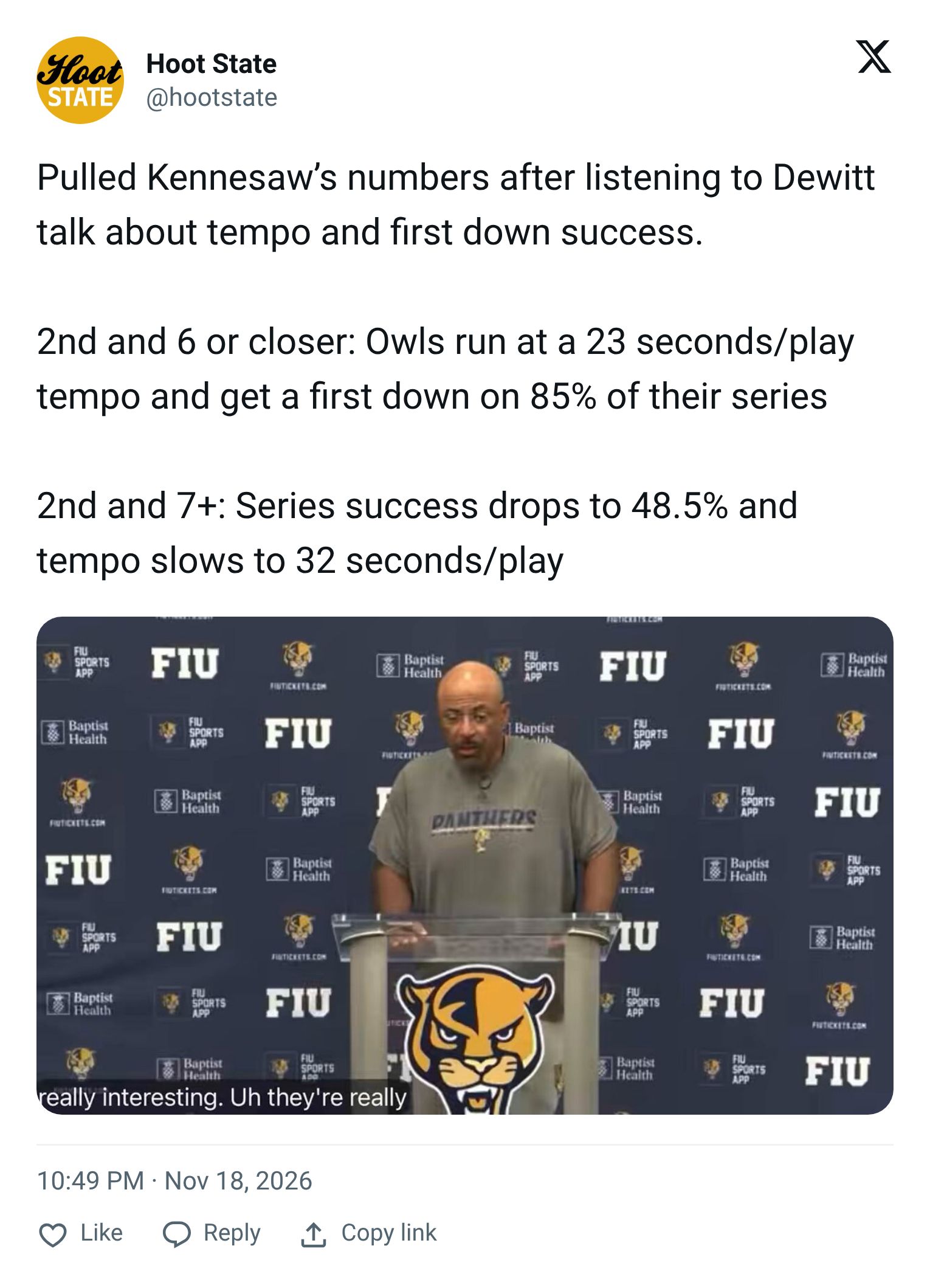
Night and day difference with this offense when they can utilize Mitch Militello’s entire play sheet on second-and-manageable. Compared to the FBS average, the series success rate is 8% lower on 2nd & 7+, and 4% higher when the line to gain is 6 or fewer yards away. Not exactly groundbreaking intel that it’s important to gain yardage on first down, but the Owls have a wider variance on both ends of the spectrum.
Here are a few other scientific discoveries you may or may not find interesting.
Next question: I wanted to figure out at what point of field position does a team’s odds to score a touchdown cross over the 50% threshold.

Liberty and Delaware are rolling on offense, brother. The model was also so screwed up by the offensive incompetence from Sam Houston and Missouri State that it tried to spit out a negative number initially. As in those two teams would have to drive the ball through the end zone and into the bleachers before you feel good about scoring a touchdown.
Change the percentage to 75% and include field goals, this is the opponent’s yard line to reach. Liberty and MTSU rise to the top due to having lights out kickers so far this season. Sam Houston, sadly still doesn’t exist.
MTSU: 47
Liberty: 45
Delaware: 45
WKU: 37
Jax State: 35
Kennesaw: 34
Mo State: 17
FIU: 7
NMSU: 4
Sam Houston: Never
I also broke out each team’s points per drive based on when they reach a first down past certain areas on the field, to give a little more clear picture as to how efficiency develops as each team’s drive progress.

Looking at a couple of these charts makes me even more frustrated about that punt on the first drive against Liberty. You almost certainly know what’s going to happen when you hand the ball back to them, so you can’t waste your own opportunities in plus territory on manageable fourth downs.
One quirk in the touchdown/field graphic that’s explained by the full points/drive numbers: Jax State ranks third overall in points per drive, but Gamecock drives don’t hit the gas pedal once in opponent territory like Liberty and Delaware. JSU ranks 49th overall in drive success rate (basically anything where you score points), then drops down to 112th on drives that cross the +40 yard line. It gets even worse in the red zone, where they rank 122nd nationally. Odd stuff that’s potentially worth diving deeper on.
Along with the team level offensive efficiency, we also took a look at some individual numbers over on defense, including pass-rushing and a broader view of run defenders. FIU will come to town this weekend with two of CUSA’s top three pass rushers, plus another guy in 15th for good measure.

On the ground, this one is obviously pretty tough to see but you may find it interesting to get a look at the most common run defenders for each team, along with underlying metrics like stop and missed tackle rate, tackle share, depth of tackle, etc.


